
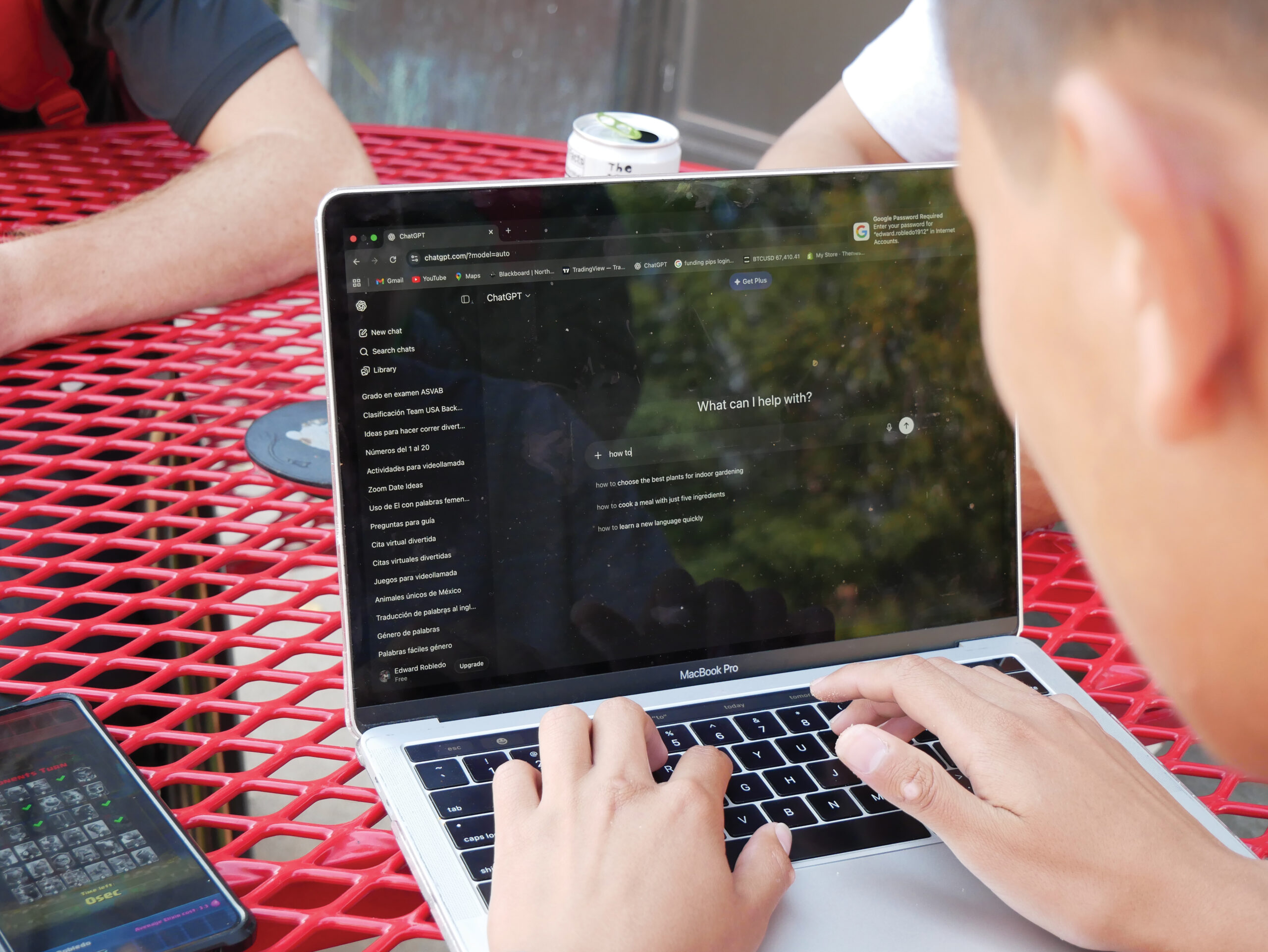

Professors should teach students how to correctly use AI instead of using it incorrectly.
“A lot of students are just learning how to use it and there is a correct way to use it, and there is an incorrect way to use it, and I think if we teach our students the correct way to use it would be better,” English professor Roxie James said.
James gave an insight on the challenges of AI being used in education and even here in NWOSU, and how students can use it correctly if taught properly. In her years as a professor here on campus, she has caught students using AI to do their work for them.
Students get caught using it when professors know how a student writes and speaks. When the student uses AI to do the writing for them, a professor can catch sentences that don’t sound like them. Teachers also understand the tone in which the students speak as well.
James spoke about the diversity between students who have technology versus students who don’t have access to technology, or AI.
“I think AI does divide people in different groups differently,” she said. “So there are students who have little access to technology and they are using basics, and you have students who have more access, but maybe they are under financial strain. … Most all of the AI programs have a paid version that is clearly better than the free version.”
AI has been talked about all over campus. Many teachers rely on it to prepare for classes. But what’s not talked about is AI’s role in the workplace.
“I wouldn’t say AI has taken over the workplace yet at least not for us,” said Craig Ricke, director or IT at NWOSU, “but it does make some of thing we do easier, and it seems to be pretty good at scripting and con coding. It’s good for helping with searches, and we are finding that AI comes across as very confident with its answers even when it’s completely wrong with its answers.”
The reason AI is confident with its answers is because it’s programmed to provide an answer and lacks a true understanding of truth or self-awareness, instead operating on probabilities derived from its training data. In some instances, AI can be wrong even if it thinks it is right. Some of the technology and even AI has its flaws, according to Copilot, an AI product built into Microsoft programs.
“It’s a bit like having a super-enthusiastic intern who doesn’t always double-check their sources,” Ricke explained. “With the coding, it has taken jobs that we may spend a week trying to figure out how to code and it does it just a few seconds.”
AI overall can really help the speed of things and help the workers get stuff done in a matter of seconds, instead of spending weeks trying to complete a task.
“So far, no, it has no negative impact on employment,” Ricke said. “I know that there are predictions that a lot of jobs are going to be replaced by AI, and some may, but I think it’s going to be OK. Right now what I’m seeing is AI is used to enhance what a worker does but not completely replace them.”
Rickie gave advice to future employees who are going to have a job in a workplace that is run by AI.
“You are going to learn how to use AI or you’re going to get left behind,” he said.
In an article titled “New Horizons,” author Taylor Karl said there are two cons for AI in a workplace: job displacement and ethical concerns.
One of the most substantial drawbacks of AI is job displacement, Karl wrote. As AI systems are increasingly employed to automate repetitive tasks, there’s a potential risk for significant job losses, particularly in specific industries. Consequently, this can cause considerable changes in the job market and the workforce. However, it’s important to note that AI is projected to generate more jobs than it’ll take away.
“The second con would be ethical and privacy concerns. Another concern with AI in the workplace lies in the ethical dimensions of implementing such technologies. Decisions made by AI may be affected by biases inherent in the training data, which can lead to unfair consequences. Moreover, there are serious questions about privacy and transparency. AI systems often rely on large amounts of data, raising sensitive data usage and protection issues.”
AI also has a role in video games.
Gamers tend to think AI is biased or unfair. Evan Vaverka, NWOSU Esports coach, agrees with some of that criticism.
“If the AI is being used as like a bot in gaming — like you got Battlefield 6 and they want to have a full map of people — generally, I would consider AI like that, biased, unfair, or giving any problems, and they might play a little better than some people, but it might not play as good as others.”
Vaverka said AI can sometimes be better at the game than others, but sometimes the players can also be better than AI.
According to Juego Studios, the implementation of AI in video games is a multifaceted challenge that encompasses technical, logistical, and creative aspects. Developing AI algorithms that enhance gameplay, provide challenging opponents, and adapt to player preferences requires a deep understanding of both game design and AI technology. Integrating AI seamlessly into existing game engines and workflows can be complex and time-consuming.
Additionally, maintaining the balance between AI-driven content and human-authored content is essential for creating enjoyable and engaging gaming experiences. Striking this balance demands a collaborative approach, where AI augments the creative vision of human developers rather than overshadowing it.