
By Karolina Juresiute Arensdorf
A drone hums low over a potato field; it sees the tiny weeds almost hidden among the crops. In just a few seconds, it sprays the unwanted weeds while leaving the potatoes untouched. The same kind of technology is helping students in the classroom and health professionals by giving faster ways to sort patient data.
This technology called artificial intelligence is showing up in many different places: in the classrooms where students use AI tools to practice or improve learning, in fields where drones can tell a difference between a weed and a plant in just a few seconds and hospitals where various information is being sorted to improve patient care. AI has been a hot topic since its initial release, which felt like science fiction.
Some people describe it as a mix of excitement, uncertainty and even a little fear. It is moving quickly from theory to practice.
“AI is a computer program that is intended to mimic human thinking, which it does not truly do; it’s just running a program of a very large data set,” said Craig Ricke, director of information technology at NWOSU. “We have found it is really good at coding, like if we have something that needs done in a file, certain things found and replaced with something else, it can do that very well in a text file. It can write scripts to help us move files or process files.”
AI is beginning to reshape how people handle everyday challenges. Students, educators, farmers or even healthcare specialists believe AI to be a great tool that helps save time and is efficient.
“I kind of use it on a daily basis just for searching instead of Google and typing questions in AI because it kinda gives me a broader search range,” Ricke said.
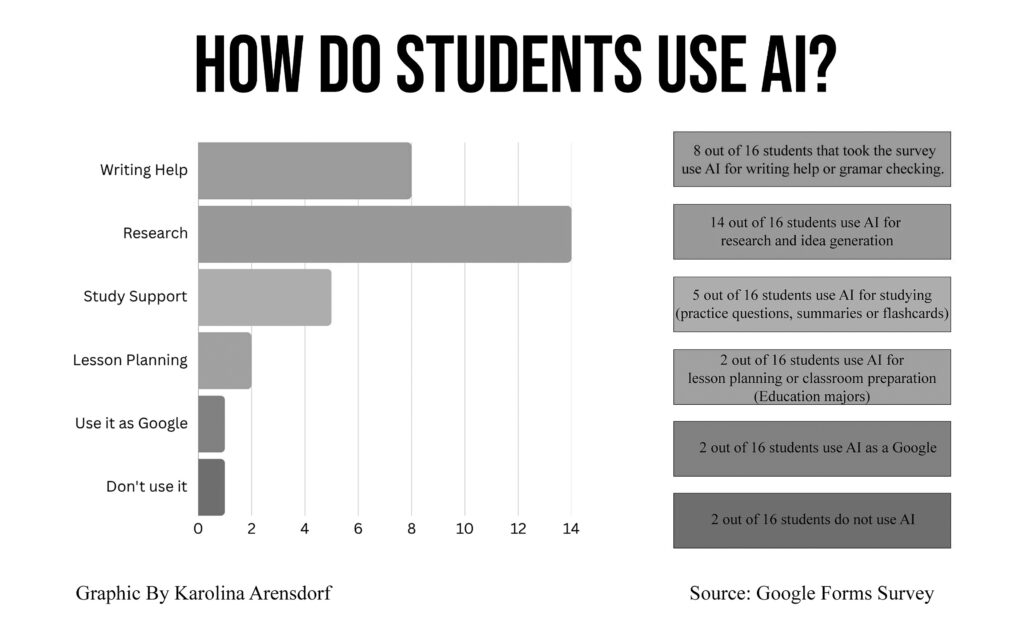
In the classrooms, students use AI more often. Some use it for bad habits of cheating, but many use it as a learning tool.
Some use it to check their writing, some ask AI to generate questions of their study guides to learn the material better, some use it for research.
Janie Rempel, a junior education major from Forgan, said she uses AI only if the professors allow it.
“I use it mostly to help formulate thoughts or ideas for lesson plans, and then I revise them and make them to fit how I like to teach and the activities and stuff that I like to use,” Rempel said. “I just like to get ideas from AI and then make them my own.”
According to Washington State University’s Benefits of AI article, AI offers advantages for both students and faculty. From a student’s perspective, AI is an efficient study tool, career guidance, free or low-cost academic support or it can provide personalized learning. For faculty, AI can be helpful with automated administrative tasks, increasing productivity, enabling better student assessment and new forms of continual learning.
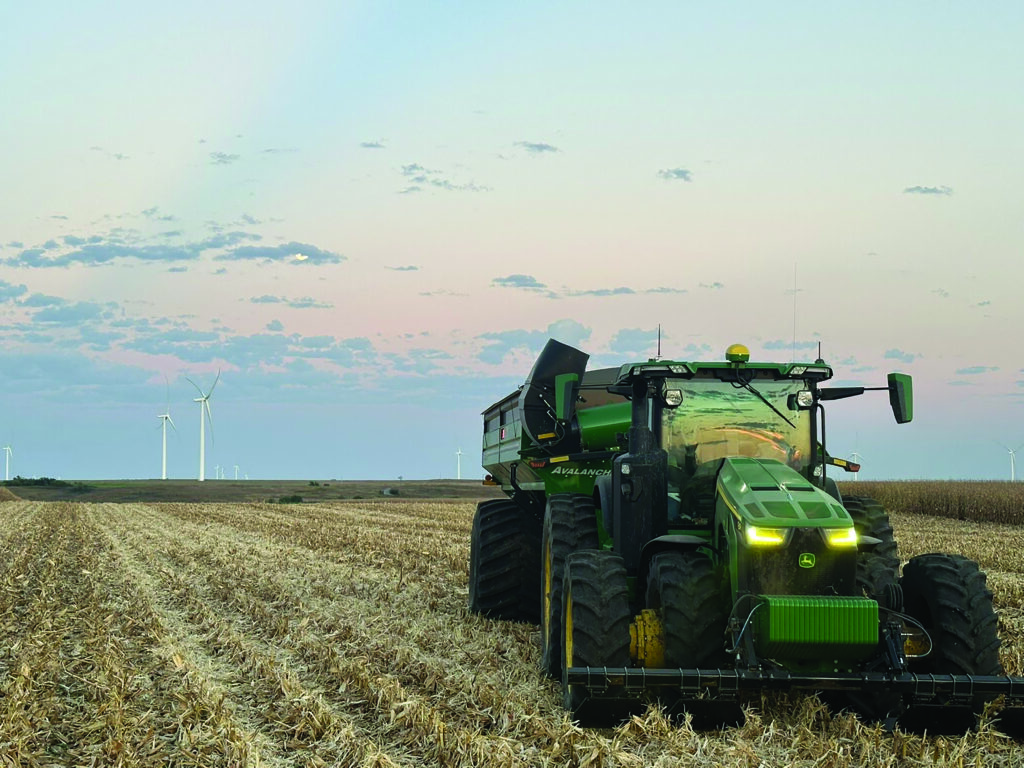
On farms, AI has been beneficial and lately has been used more and more. Drones and AI features give farmers specific information about their fields. They can see exactly which parts need water, pest control or fertilizer.
Dr. Kent Martin, assistant professor of agriculture at NWOSU, said he recently saw how advanced precision-spraying technology has become.
“Last winter I was at a conference – Washington Oregon potato conference – and they had a drone that could identify a weed from a plant, even similar, we would call it plant architecture, so similar looking leaves and similar growth habits of the plant and could still distinguish them as it’s flying through the air while making a herbicide application at the same time,” Martin said. “So, the speed of that decision making process, the ‘I see a weed, I need to spray that weed and not the crop next to it’, and to do it all in real time, at airspeed is really impressive.”
Another impressive AI tool to help out with livestock management is rotational grazing system. AI-powered collars can be put on cows, and they would track the movement and health of the cattle. It can also tell when the cow is calving or if there’s something unusual about it.
“We now have collars that we can put on our cattle that can establish virtual fencing for cattle, and it doesn’t shock the cattle, but it releases a tone, and this tone teaches the cattle where to go and where to stay,” Martin said.
“These were developed in different parts of the world where rotational grazing of smaller land areas is important, time consuming for putting up fences,” Martin said.
While most farmers still use manned tractors, autonomous tractors powered by AI are the next big thing in agriculture’s world.
“We can send it out, and we can have it do a task for us without even being in the piece of equipment,” Martin said.
Utilizing AI in everyday practices
Continued from page 1.
“That demand on AI is much greater because we have to then understand not only when something breaks, but if something is close to breaking, or if some set of conditions is abnormal, AI is going to evaluate that and let us know.”
“AI technologies are vital tools and not just some flashy add-ons,” Martin said. “They help agriculture keep up.”
Lastly, AI in healthcare is expanding quickly, especially as a tool for sorting through huge amounts of medical data and saving time for providers.
Dr. Leslie Collins, Charles Morton Share Trust division of nursing chair and professor of nursing at NWOSU said the technology is already reshaping how researchers analyze information.
“I know it’s being used quite a bit in research and just being able to take large amounts of data and include it in a more workable fashion so that interventions can be changed and patient care outcomes can be changed in a positive light,” Collins said.
The NWOSU nursing program uses AI quite a bit for research purposes.
“It is something that is newer to us as well and what we are really trying to focus on is teaching our students how to use it appropriately, how to understand what AI is, how the information from it is generated, and how they can use it to benefit them and to ensure that the outcomes that they are receiving is professional, ethical research items that they can base their care upon and their beliefs upon,” Collins said.
“One of the ways that AI is really beneficial to nursing and nursing education is to ensure that the information being shared is easily understood by a large number of people. It can help to make sure that things are clear and concise,” Collins said.
AI works best as a tool and not as a replacement.
People need to understand how to use it correctly and use all its benefits.
“I have to admit, when I first started hearing about it, I was really concerned about what it meant, what it meant for the quality of work that was going to be, you know, just put together in all sorts of different arenas,” Collins said.
“And what I now have learned is that there are ways that you can use it, and then it can be beneficial to you and to your time and to efficiency.”