
By BRAXTYN TURNER
The lights begin to dim inside Fellers Family Auditorium. A faint hum of anticipation fills the room.
As the curtains open, a strange green plant at center stage begins to move. Within moments, the audience isn’t just watching a production; they have been transported into the comedic and magical world of “Little Shop of Horrors,” where love, hope, a beat of darkness —and a man-eating plant— take center stage.
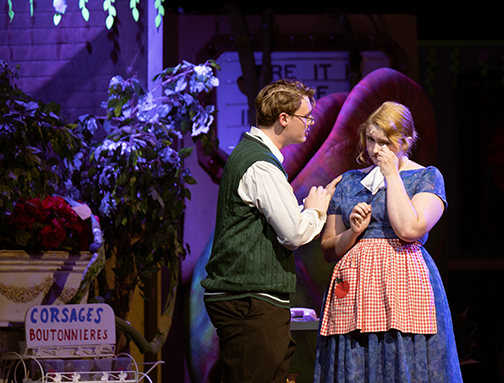
With its original debut in 1982, “Little Shop of Horrors” began as a low-budget Off-Broadway production. With its rise to fame, and movie adaption, it quickly grew into a cult classic. The musical blends dark comedy, music, romance and sci-fi into an entertaining theatrical experience. The story follows its main character, Seymour, as he discovers a mysterious plant that promises him fame and fortune— at a cost.
“The movie is a cult classic, and with that, people have their expectations,” said Kimberly Weast, co-director of the production and director of the theatre arts program at NWOSU. “But truthfully, we’re just trying to tell the story. I’m not really worried about what they’re doing with this in New York right now.”
Bringing a production of this scale to life is not simple, it’s filled with elaborate sets, props, choreography and technical elements.
A show like this requires significant funding, time and talent. Through this production, NWOSU Theatre gives audiences the opportunity to experience a well-known classic close to home.
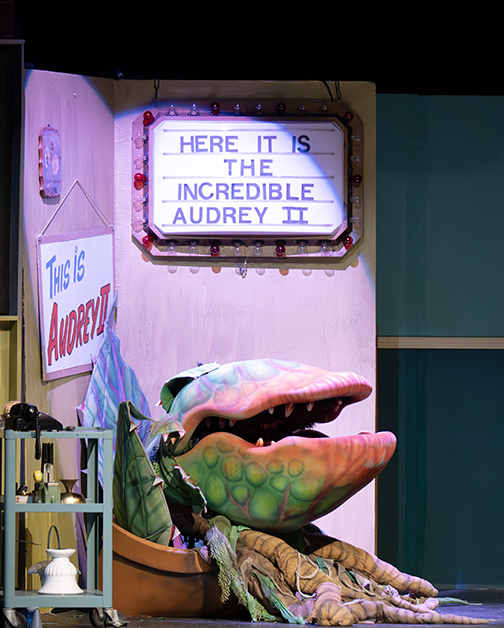
One of the most demanding aspects of the production is the complex sets and designs. The show’s centerpiece is a growing, man-eating plant.
The effect involves several puppets, coordinated movement and contributions from both the performers and crew. Timing and stage design is critical for this type of show.
Co-director and instructor of technical theatre Mickey Jordan explained the challenges of working with the ever-changing focal point of the set.
“From the front door of the flower shop to the edge of the pit, there’s only 9 feet,” Jordan said. “With the plant, it grows four times, and so, having to work around how we will have room for that and how the audience will see it, it’s been a lot of fun.”
Weast also commented on the large prop and its challenges. She explained that the theatre department chose to rent the plant instead of creating their own in order to save time and resources.
“It would’ve cost us more money to make our own prop than to rent it,” Weast said. “We rented the plant from a theatre production company who rents the prop to go all over the nation. The plant and all its parts came from a company in California, but it was actually shipped to us from Pennsylvania. When we are done with it, we will send it to wherever it needs to go next.”
The show itself follows Seymour, a shy florist who stumbles upon a mysterious plant that begins to change his life in unexpected ways. As the plant grows, so does Seymour’s confidence. It draws him into a world of ambition and complicated choices. The story blends humor and heart with a touch of the unexpected, giving the actor behind Seymour the challenge of portraying both his awkward charm and his evolving determination.
Lucas Wood, a sophomore business major from Enid, was cast as Seymour. He said his biggest struggle in taking on this character was channeling the energy that comes with the heavier themes throughout the show.
“As an actor, you have to be able to think of sad things from your life and apply them to that scene,” Wood said. “I think that has got to be the hardest thing because if it’s too sad, then you’ll break down on stage and it just won’t be good.”
Wood said he was excited to take on a production that college students are more aware of.
“I haven’t really seen it as pressure that this is something a lot of people know,” Wood said. “I’ve seen it as, ‘let’s see how we can change this up to surprise them in a completely different way.’”
Music plays a large role in the energy and storytelling of “Little Shop of Horrors,” and the show combines many different genres to bring the story to life. Cast members move seamlessly between dialogue and song, requiring precision and strong chemistry as the music shifts between upbeat group numbers and intimate duets.
Justus Durham, a freshman speech and theatre major from Brighton, Colorado, plays Orin— who is also known as “the dentist.”
He spoke about the vocal challenges of his role. He explained that the character has a much lower voice than his, so singing in a lower range was something he really had to focus on for the role.
“I always need a drink of water and a small break after singing the last song he has,” Durham said.
As Seymour navigates the world with this strange plant, his relationship with Audrey becomes the focal point of the story. Audrey is a kindhearted character who longs for a life beyond the walls of the flower shop.
Her connection adds emotional depth to the story and helps balance the darker elements with moments of hope.
“When I was cast as Audrey, I just felt so honored to be able to take on the iconic character,” said Jaden Matthews, a senior speech and theatre major from Hennessey.
“There’s definitely a lot to live up to, dealing with this character that is so iconic, while still trying to put my own spin on it. I’m just very excited to show people how I see Audrey.”
Opening night is Thursday and Northwestern’s theatre program has worked nonstop to prepare. From long rehearsals, to detailed technical work, cast and crew are prepared to bring a fresh perspective to a well-known story.
Weast said she hopes that the audiences will see the fun and passion behind the program telling this story.
“We spent many Mondays and Saturdays, many afternoons and evenings, just trying to create a flower shop set in the 1950s,” Weast said.
Northwestern’s productions of “Little Shop of Horrors” will take place at 7 p.m. on Thursday and Friday and 2 p.m. on Sunday in Fellers Family Auditorium. Tickets are $5 for students and seniors, $10 for Northwestern employees and $15 for general admission.