
By KAYLENE ARMSTRONG
When I came to Northwestern 11 years ago to teach journalism, I heard the same stories that have been told for decades about why Jesse J. Dunn Hall — yes, that is its official name — has so many stairs.
Guides giving tours on campus will tell the same story: men building the hall in 1935-36 during the Great Depression, got paid more money for stairs, so the architect added more stairs to the plan.
That explanation never ran true for me, and eventually in 2018 I started researching about the building in hopes of finding out the truth.
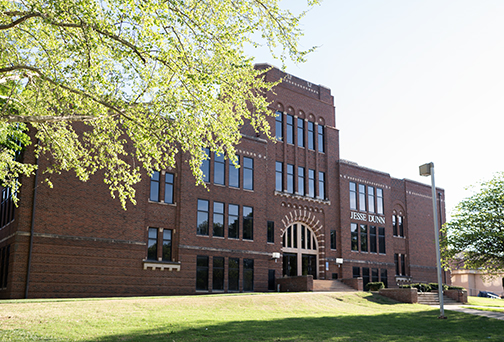
Now that I am retiring and leaving the area, I need to share what I found so far. First, I didn’t discover why the building has so many stairs, but I came up with some plausible theories about why the more-stairs-for-more-money explanation probably isn’t true and why the building has some weird architecture.
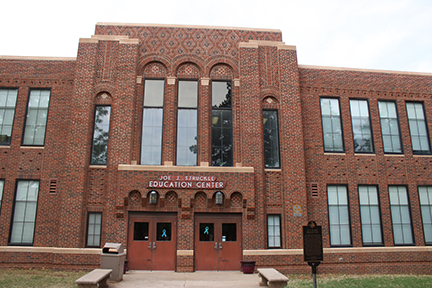
Before we get into the theories, we need to start with a quick history of Jesse J. Dunn Hall and its smaller sibling, the Joe J. Struckle Education Center. The two were built at the same time.
Though I have enough information for a much longer story, here’s the highlights.
• It started with a fire in the middle of the night, about 2 a.m. The date was Friday, March 1, 1935. The fire was in the oldest building on the Northwestern State Teachers College campus: Castle on the Hill, Old Main or the administration building—take your pick. It was called all three names at times.
The Alva Daily Record, the town’s newspaper in 1935, usually called it the administration building or Old Main.
The Northwestern Territorial Normal School building, completed in 1899, was the second normal school building in the state, according to the newspaper. The castle-like structure of the normal school made it a show piece that travelers went out of their way to see in those days.
(“Normal school” is what people called teacher colleges in the 1800s. Dozens of colleges and universities to this day call the administration building “Old Main.”)
• Many people in Alva hoped to rebuild the Castle just as it was, but that didn’t work out. Instead, John Duncan Forsyth, a Scottish architect who settled in Tulsa, was hired to design the new building. Various estimates to rebuild ranged from $300,000 to $500,000.
• Getting state funds to rebuild happened quickly. Within two weeks after the fire, the Legislature passed an emergency funding bill for $300,000—$250,000 for building a classrom and library facility, and $50,000 for equipping it.
• In a move that seems unusual today, the Legislature followed up on April 8, 1935, with a concurrent resolution that named the new building Jesse J. Dunn Hall. In the last few years, NWOSU officials, with the approval of the Regional University System of Oklahoma that governs six Oklahoma universities, including Northwestern, have renamed buildings on campus. Fine Arts, which started as Science Hall in 1907 and then Vinson Hall 1938, then Fine Arts in 1939, became Ryerson Hall in 2019. South Hall, a dorm, became Cunningham Hall in 2023.
• The college had been trying to get state funding for a training school building in 1935. In those days, the students came to the student teachers who taught classes on campus. Many teachers colleges built what amounted to a public school for elementary through 12th grade on their campuses. On April 5, 1935, the Alva newspaper reported the Legislature killed a bill to spend $73 million on college campus buildings, including a training school at Northwestern.
• On May 31, 1935, the college received permission from the State Board of Affairs to pursue additional federal funding for two building projects (Jesse Dunn and the education building), which it did. The application went to Washington, D.C., in July, along with five other state projects. (Interesting side note: It was stipulated that when the education building was completed, the old Science Hall, now Ryerson, was supposed to be torn down. It didn’t happen.)
• On Sept. 10, Harry Hopkins, who ran the newly formed Works Progress Administration, rejected the Northwest application along with a stack of other projects. Under pressure, Hopkins changed his mind and a few days later said he would review the projects.
• On Sept. 28, in a telegram to acting President Sabin Percefull, Alva learned the $244,995 federal grant had been approved, so both Jesse Dunn and the education building could be built. The Alva Daily Record reported bands played and bells rang, celebrating the news.
• Construction began in late November. The contractor went through the Woodward re-employment office to request for workers certified to work on WPA projects to come that first week; only one showed up, the newspaper reported.
• Excavation started first on the education building. The construction engineer worried about the digging that would take place for Jesse Dunn. It would require moving dirt from the hill behind the building to the front to level out the area for the first floor. Rather than reuse any of the foundation from the old building, all the concrete had to be dug out, the newspaper reported. It rests 15 feet north of the old building site and 40 feet to the west, completely covering the old foundation.
• The Horace Mann Hall, which is what the new training school was called, was finished first in late 1936. Jesse Dunn, with the science annex (now Carter Hall), was finished last. It was delayed when the plans for the library (now the museum) had to be redrawn to accommodate more books.
• The library’s air-conditioning was the first for a college building in the state.
• The dedication for both buildings took place on March 12, 1937. The highlight was former first lady Eleanor Roosevelt speaking. The podium and chair she used are now safely stored on the third floor of Jesse Dunn.
Some surprising facts:
• When Hopkins denied the application, some people worried that construction would be further delayed because the building would have to be redesigned so that only the state money would be necessary to cover the cost.
However, architect John Duncan Forsyth said he had included two annexes to the Jesse Dunn building, and these could easily be removed without major redesign work if only one building could be built. When the funding came through and the redesign wasn’t required, only one annex was built. Without the original plans, no one knows where the second annex would have been built, what its intended purpose was or why only the one was built. Cost is the likely reason, though.
• Tunnels run under Jesse Dunn, Carter Hall and the current Jesse Dunn Annex (added in 1968). These tunnels were used for heating pipes when the campus had a central heating system and for other utilities.
Maintenance workers still occasionally go into the tunnels, which are found between and under most of the old buildings on campus. One worker said some stairs that seem to lead nowhere are located down in the tunnels under Jesse Dunn, and he thinks they could be from the old Castle.
• When James Ament, the first president of the Northwestern Territorial Normal School, learned about the fire, he contacted then-president O.E. Hatcher and said he would be sending his photo to be hung in the new building. It arrived three days later.
Whether it ever hung in the building is not known. It does not now. You can, however, find Jesse Dunn’s photo in the hallway off the front stairs on the second floor.
• When Gov. E.W. Marland signed the emergency legislation that provided $300,000 for the Jesse Dunn building, he used four pens, according to the Alva Daily Record. Three men who helped get the legislation passed were to each receive one, and the fourth was to be displayed in the new building. I haven’t found anyone who knows what happened to the pen—if it actually made it here, that is.
• Architect John Duncan Forsyth designed two other Northwest buildings, both former dorms on campus that were built in 1939: Shockley Hall and Vinson Hall. Like human siblings, these buildings look so much alike that it is clear they were designed by the same person. Forsyth is also listed as the architect on a 1930s renovation of what was then Science Hall.
• Almost everything written about Forsyth, who died in 1963, leaves out his work at Northwestern. A published history of Forsyth, written by one of his colleagues in 2007, mentions many of his most famous creations, such as the Marland Mansion and the State Capitol Office Building. However, his work at Northwestern doesn’t even merit a footnote.
A biography written (but not published) by his stepdaughter, Jean Ache Ladner, featured individual pages for each of Forsyth’s works by location. The Alva page lists Northwestern Oklahoma Teachers College but no specific buildings.
• When the Jesse Dunn building was designed, the history department was assigned to the third floor. It still resides there today.
Southwest corner of building has unusual design
The weirdest part of Jesse Dunn is the southwest corner with the entrance most people use to enter the building when coming from the rest of campus.
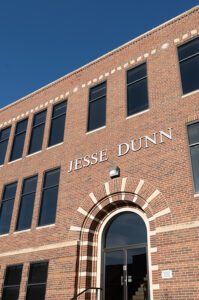
In fact, the southwest part of the building is about half a floor higher than the corresponding floors in the rest of the building. The first floor of this section is where the printshop and its workrooms are located today; some art rooms, an office and the business conference room are on the second floor
I think this entrance was actually supposed to be lower, so when you entered the building and went up the stairs, you were on the second floor of the building, like the entrances from the west and north.
Instead, when you enter the building on the south and go up those stairs, you are on a landing ABOVE the second floor of the main building. A few steps across the landing and you have to go DOWN some stairs to the second floor. Extra stairs.
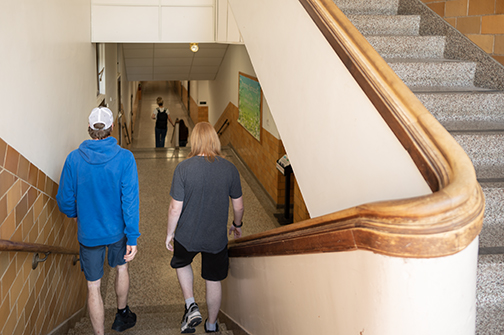
Also, when you enter the building from the south and go down the stairs, you have to cross a small landing just like on the floor above, and then descend another set of stairs to get to the first floor of the building. Basically, you go down a floor and a half to reach the first floor.
Also, all the door numbers on the first floor of this northwest section are numbered at if they are on the same level as the agriculture department a half a floor below; door numbers on the second floor of this section correspond with the numbers on the second floor of the main building.
Why lift up that part of the building half a floor? I propose the answer is shale.
A geologic map of the area completed by Galen W. Miller and Thomas M. Stanley in 2003 shows flowerpot shale underneath a large part of campus. You can find the map at https://ogs.ou.edu/docs/OGQ/OGQ-42-color.pdf. You have to zoom in to the corner of Oklahoma Boulevard and College Avenue to orient yourself.
In a short interview, Stanley said hitting shale while excavating for a building would create a tough digging situation. Though he couldn’t say what happened in the case of Jesse Dunn, it is not unreasonable to propose that part of a building would be built on top of the shale rather than trying to go through it.
So maybe all the stairs in Jesse Dunn are just what had to happen to make the architect’s vision become a reality in the location it needed to be built.
Maybe it is that simple.