
By CORKY HALL
Weast: Kid’s theater is favorite at NWOSU
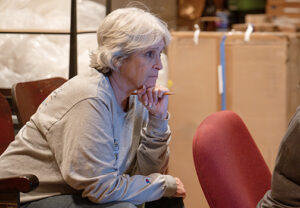
Kimberly Weast watches rehearsal Tuesday for “Little Shop of Horrors.”
After more than two decades of shaping NWOSU’s theater program, Kimberly Weast is taking her final bow.
Weast, who joined Northwestern in 2002, is retiring after 24 years at the university and more than 36 years in higher education. Over the course of her career, she has directed or produced nearly 90 theatrical productions, not including pageants, concerts and other events she has designed and directed.
She will be leaving behind a legacy measured not just in performances but in the students she inspired along the way.
For Weast, the heart of theater has always been the process.
“I really do like the process of getting the production ready,” she said. “Working together as a theater company to bring something to the public, I’m going to miss that.”
Those who worked alongside her say her dedication never wavered. Jesse Schroeder, assistant professor of communication and NWTV adviser, has watched Weast’s impact on the program firsthand.
“Her passion for theater has never dropped,” Schroeder said. “She really helped push for improvements to the auditorium, and her expertise played a big role in what we see today.”
Throughout her time at Northwestern, Weast witnessed both growth in the program and transformation in her students. While advancements in lighting, audio and production technology elevated performances, she says the most meaningful changes were always personal.
“I love seeing students who maybe didn’t have many opportunities before falling in love with theater,” she said. “Watching their eyes light up when something clicks and the pride they feel when a show comes together. That’s what I’ll miss most.”
That transformation is something her former students remember well. Alica Hall, coordinator of printing services and a Northwestern theater alumna, saw the program evolve under Weast’s leadership.
“I got to see what the program was before and everything she’s done to move it forward,” Hall said.
She emphasized the hands-on nature of the training Weast provided.
“You didn’t just learn one thing; you learned every part of theater,” Hall said. “At a small school, everything can fall on your shoulders and she prepared us for that.”
Some of Weast’s favorite memories include late nights with students filled with hard work, laughter and plenty of coffee. Among standout productions, she recalls directing “Oklahoma!” during the state’s centennial celebration and the department’s annual Theatre for Young Audiences shows as especially meaningful.
“That’s probably my favorite,” she said. “Directing and producing those productions for young audiences—it’s just special.”
Beyond the productions themselves, Weast built something lasting in her students. Hall said the program felt like more than just an academic department.
“It was always a team, but it was also a family,” Hall said. “She treated her theater students like her children. We were her family.”
Weast also played a central role in the physical transformation of Northwestern’s theater facilities. Helping to see the theater renovation through to completion was a goal she had carried since the day she was hired.
“When I was hired, that was one of the things we talked about,” she said. “To see that come to life after all these years, it’s a major accomplishment.”
Mickey Jordan, director of technical theater, has known Weast for 11 years, first as a student in 2015 and now as a fellow faculty member. His introduction to her was not quite what he expected.
“The first time I talked to her on the phone, I thought, ‘This lady is going to eat me alive,'” Jordan said. “But when I met her in person, she was one of the kindest people I’d ever met.”
That kindness, Jordan says, extends to every student who has come through the program.
“She saves every student’s name, hometown and birthday in her phone so she can check in on them,” he said. “Not everyone does that.”
From first-year students learning the basics to seniors completing capstone productions, she watched generations grow in confidence and skill.
“There are so many proud moments,” she said. “Seeing students overcome challenges and succeed. That’s what it’s all about.”
Bell: Teaching always career focus
By MEGAN SPRAY
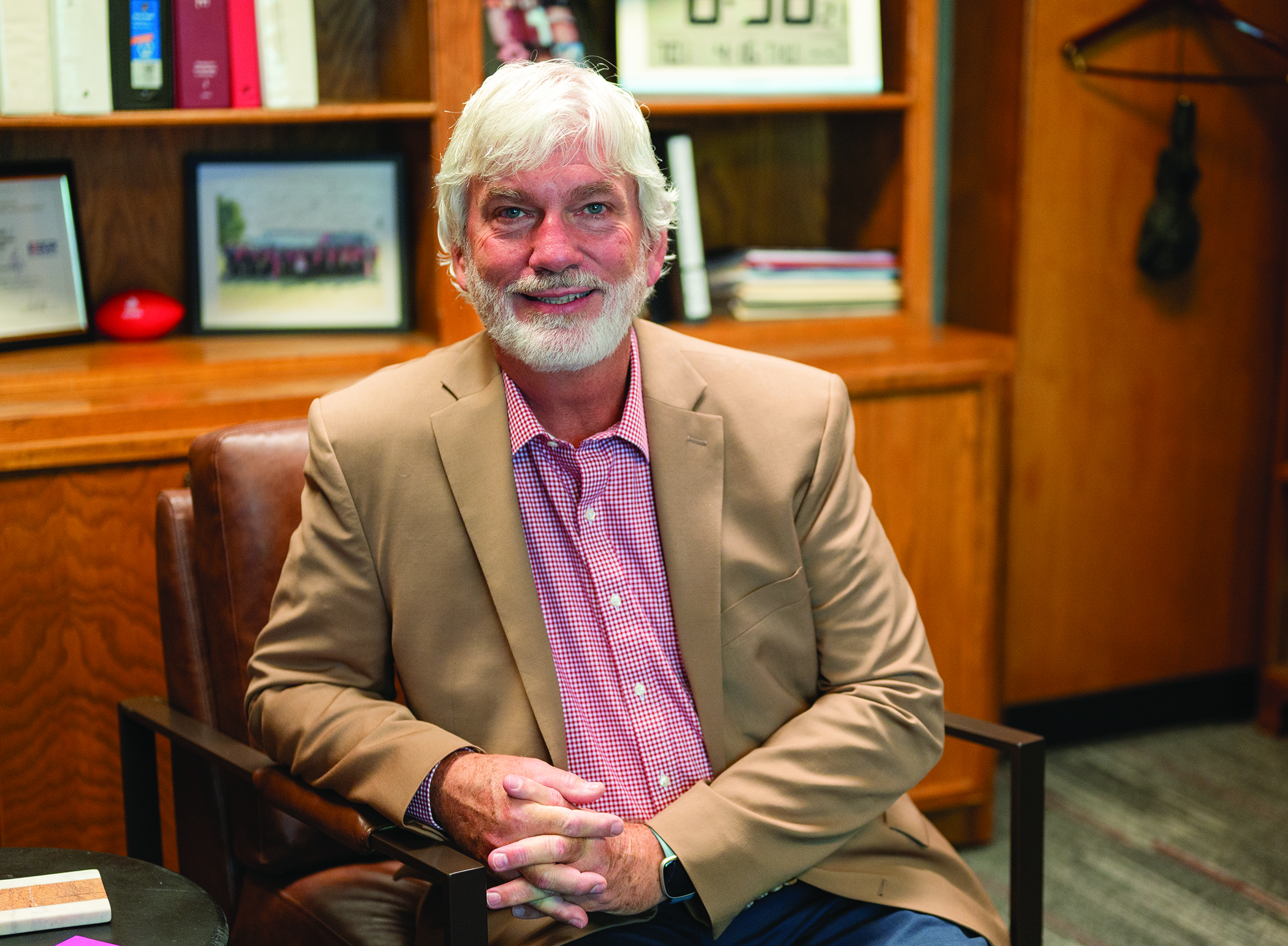
After more than four decades in education, Dr. James Bell, vice president for academic affairs, is preparing to step away from his role at Northwestern and begin a new chapter in retirement.
Bell said his career in education began in 1986 as a high school teacher before transitioning into higher education. Over the years, his work has included teaching English, teaching courses and serving in administrative roles.
“I’ve been in education for 40 years,” Bell said. “I’m looking forward to seeing what the next adventure is.”
Bell has spent about 15 years living in Alva and serving Northwestern. He said the university and community became a place that felt like home, leading him and his family to remain in Alva even after retirement.
“I have loved the fact that we are in a community of 5,000 that has that hometown feel,” Bell said. “I can go to an NCAA basketball game and be home in 5 minutes. It’s the accessibility of everything.”
Bell described his time in education as divided into three major stages: teaching high school, teaching college courses and serving in administrative leadership. He said teaching has remained a consistent part of his work, even while managing administrative responsibilities.
At Northwestern, Bell previously served as an English professor before moving to his administrative position. He continued teaching courses, including film and leadership classes, throughout his time in administration.
President Dr. Bo Hannaford, said Bell’s dedication to teaching was visible throughout his entire career.
“He always is teaching even in his administrative role,” Hannaford said. “He’s always been a passionate teacher whether it was when he was an English chair, when he was the dean, or when he was teaching film classes and now leadership classes. He loves being around the students.”
Hannaford said Bell played a key role in several academic initatives, including accreditation efforts, the enrollment and retention forum, and department developments. These responsibilities often require extensive work that isn’t always seen by others.
“I don’t think people really understand the role and behind-the-scenes work that you have to do when you’re the final person that’s in charge of doing all of the things,” Hannaford said. “He’s done a lot of great things for us.”
In addition to academic responsibilities, Hannaford said Bell maintains a strong presence at campus events and activities and regularly attends athletic competitions, concerts and performances across the university.
“He’s been all in as a Ranger,” Hannaford said.
Bell said one word that best describes his time at Northwestern is “family.” He said the sense of community among students, faculty and staff created lasting relationships throughout his career. He said that Alva provides opportunities for everyone to pursue.
“It’s the kind of place where you choose to stay when you’ve lived there for 14 years,” Bell said.
As retirement approaches, Bell said he looks forward to spending more time on his hobbies and personal interests. He said gardening, walking, reading and cooking are part of the activities he plans to fill his time with.
Bell also said traveling is a firm part in his retirement plans. He and his wife already have a trip planned for October.
“We’re going to go through and go to the balloon festival in Albuquerque and spend a couple nights, go to Sedona, then go to the Grand Canyon and camp a couple of nights,” Bell said.
He said he also hopes to spend additional time with family members, including his grandchildren.
As Bell prepares to step into retirement, both he and university leadership have had a fulfilling reflection on his contributions to campus life and academic development. His career, built on teaching and leadership, leaves a lasting mark on the university and community.
Science department will miss Moorthy’s potluck dishes
By INGRID MALDONADO
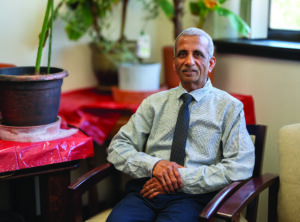
Dr. Venkata Moorthy has been a professor of biology at Northwestern since 1995 and will be retiring after this semester.
Moorthy is originally from India and began his career there where he went to S. Philomena’s College, got his bachelor’s in biology and then taught at Joseph’s College in Bangalore, India for 12 years. He got his master’s at University of Mysore in India, and his Ph.D. at the University of Oklahoma while teaching there.
“My goal is, I know a lot, yes, and I want my students to learn what I know,” Moorthy said. “And after they learn what I taught, I want them to learn more than what I know.”
Moorthy has had students excel not only in his classes but in their overall careers. He’s had students become doctors, physical therapists, dentists, nurses and some academics. One is the chair of the microbiology department at the University of Arkansas Medical Sciences.
“I have contacts with all of these amazing students,” Moorthy said. “I taught a lot of them, and they give so much respect to me because they learned a lot, and I recommended them.”
Many of his past students are in many different states, he said, some in Florida and one teaching in Colorado, but many of them are still around. His current ophthalmologist in Enid was once a student of his, as well as another eye doctor in Cherokee. Moorthy named many more past students like Shane Hansen, the Health and Sports Science Education department chair, and Kent Martin, an assistant professor of agriculture.
“It’s hard replacing someone that’s done as much in the biology department as he’s done,” said Jason Wickham, professor of chemistry.
Wickham said Moorthy has always been a big part of the science fair, does a lot of the paperwork and makes sure all the projects meet the requirements. For about 10 years, Moorthy was the academic affairs committee chair, where he approved many course modifications and new courses.
“Something you may not know about him is he is an excellent cook, and he makes an Indian dish called samosas,” said Jenny Sattler, the chair of the department of natural science. “I’ve never known how to make them, and he made fresh samosas for me and then gave me the recipe so I can make them when he’s gone.”
Sattler said it is amazing what he brings to the end of the semester potluck. She said Moorthy is a vegetarian and people never know what he is going to bring. As a favorite personal memory of Moorthy, Sattler said the samosas make her the happiest even though she has loved seeing what he has brought to the department and students.
“People forget that professors are people too, so to think that they have an outside life is kind of interesting too,” Sattler said.
Moorthy at one point taught yoga classes at the Wellness Center. He enjoys gardening and many people know about his extraordinary yard.
He said he is not going to miss teaching, but he feels accomplished and happy with what he has done. In his career he said he never spent much time on himself, and now he will spend time on himself, his family and his home.
“He’s had a spectacular career, but the thing I think he’s most proud of is his family,” Sattler said. “I’m so happy he’s going to get to spend time with his family; he deserves that.”
Longest serving professor
will still teach after retiring
By CORKY HALL
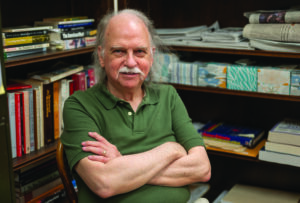
Dr. Roger Hardaway may be retiring, but he will still teach a class a semester.
Dr. Roger Hardaway has been the cornerstone of the history department at Northwestern Oklahoma State University, teaching and shaping generations of students. After 36 years, he’s finally retiring, but don’t expect him to disappear.
Arriving at NWOSU in 1990, Hardaway built a reputation as both a dedicated educator and historian. Over the years, he taught courses ranging from the American West to Native American history and 20th-century studies.
Throughout his career, Hardaway has witnessed significant changes in higher education, especially in technology. When he first arrived, there were no computers on desks, no cellphones, and email was virtually nonexistent.
He taught a variety of courses, including American West, Native American History, and 19th- and 20th-century history. He also created new courses to meet students’ needs, such as African-American history and Latin American history, ensuring that the curriculum reflected both faculty expertise and student interest.
Beyond academics, Hardaway has made a lasting impact through mentorship. Many of his former students have gone on to become teachers, coaches and professionals across Oklahoma and beyond. His influence is measured not just in lectures, but in lives shaped over decades.
That impact is something his colleague Eric Schmaltz knows firsthand. Schmaltz is chair of the social sciences department, a position he might not have held without Hardaway’s influence. “I’m very grateful to Dr. Hardaway for hiring me; that decision changed the course of my life,” Schmaltz said.
Schmaltz, who has worked alongside Hardaway for more than 20 years, also noted his role as a leader and mentor within the department, from helping hire faculty to guiding younger professors through the realities of academic life.
Outside the classroom, Hardaway immersed himself in campus life, attending athletic events and worked football games for nearly two decades.
He also built an impressive scholarly record, publishing books, journal articles and research. He is recognized in the field of the American West, specifically African Americans in the West. He is also in his 16th year of writing a weekly column for the Alva Review Courier.
Even in retirement, Hardaway does not plan to step away entirely. He will continue teaching one course per semester and remain active on campus.
“I would never trade it for any other career,” Hardaway said.
As he transitions into this next chapter, Hardaway leaves behind not just a long career, but a legacy defined by dedication, mentorship and a deep passion for history.