
By MEGAN SPRAY
When severe weather moves across Oklahoma, many people take shelter, but storm chasers head straight toward it.
For professional storm chasers, their work isn’t just about adrenaline or viral videos. It’s about the responsibility of delivering real-time information that can give people time to make life-saving decisions.
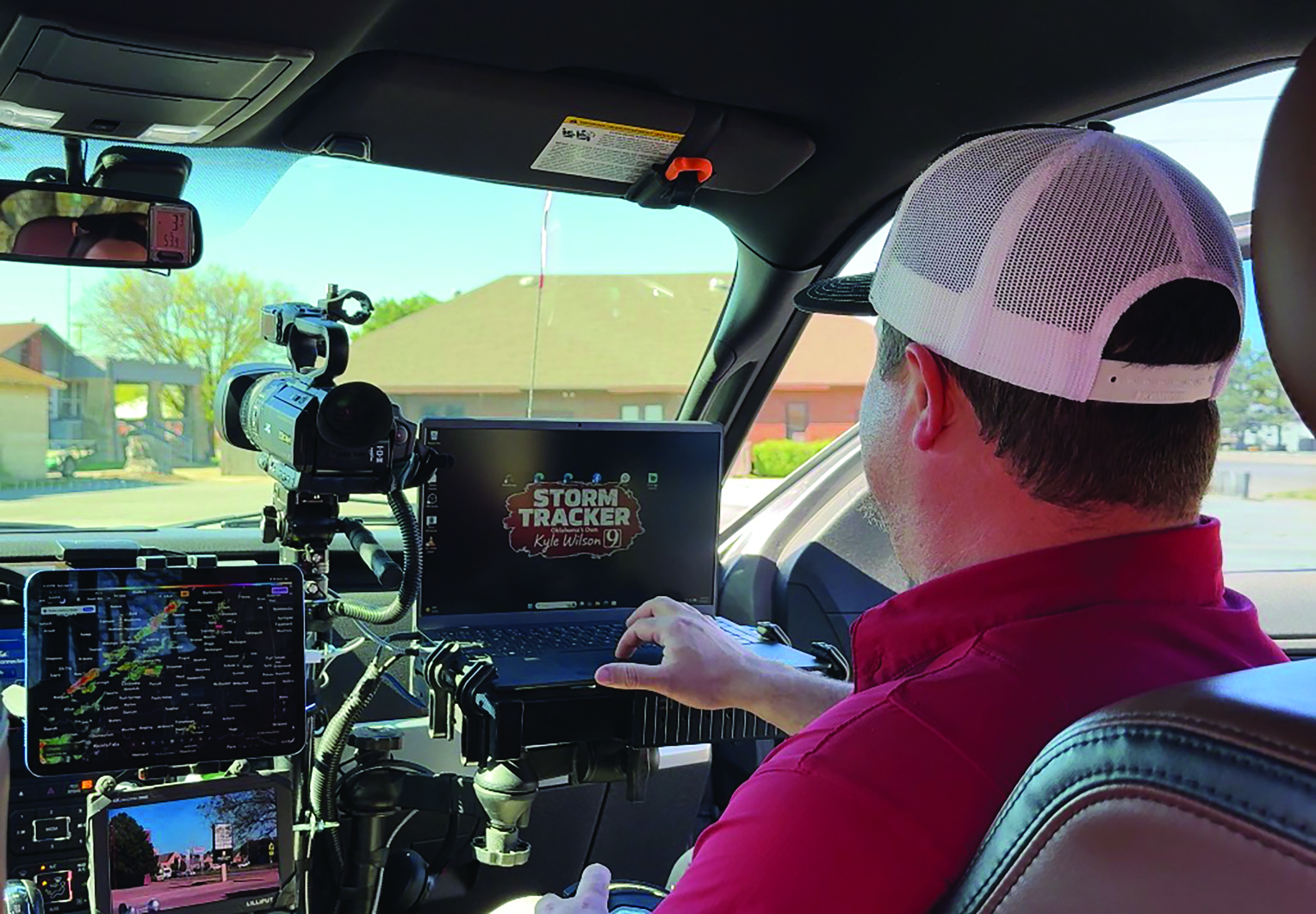
Whether it’s midnight storms, fast developing tornadoes, or long days tracking weather in the state, Kyle Wilson, News 9 storm chaser, said the goal is simple: get there first and warn others before it’s too late.
“If something’s bad, possibly going to happen, storms moving through, and whatever else, I’m going to be the one up,” Wilson said. “Even if I’ve been up that whole entire day chasing storms, I’m still going to be up.”
Wilson said he has always wanted to help protect people, which he does every day as a full-time firefighter in Woodward, and a storm chaser.
“I feel like God put me on this earth to help people and warn them,” Wilson said.
Storm chasing has long been part of Oklahoma’s identity, but the practice has evolved—bringing new technology, wider audiences and new challenges. Marty Logan, a retired News 9 storm chaser, said when he first started in 1993, he used a bag phone to communicate with the meteorologists during severe weather while also directing the camera to get footage and drive.
In the beginning of storm chasing, Logan said radar was only through Oklahoma City, and a storm would have to be two and a half miles high to be recognized on radar, so having people on the ground telling the meteorologist what they’re seeing was critical. Logan said he detected buildup of severe weather one day while out doing chores.
It hadn’t been detected on radar, so Logan called long-time KWTV chief meteorologist Gary England on his personal phone, telling him there was some weather moving and building quick. England was out working in his garden at the time, but once he got the call, he immediately went to the station. The weather quickly turned severe and even turned tornadic.
“That’s how fast these storms can do something,” Logan said. “It probably wasn’t even known that it was going to happen, but I happened to see it.”
However, storm chasing isn’t always filled with fast-paced, unexpected moments—those in the field say much of the job involves patience, preparation and long hours on the road.
Wilson said a typical day can last 10-12 hours—sometimes longer—with much of that time spent driving between storms or waiting for conditions to develop.
“You might sit there for hours, and nothing happens,” he said. “But then all of a sudden, everything changes in minutes.”
When storms do intensify, the environment can quickly become dangerous.
Wilson described a recent chase where storms rapidly strengthened, producing multiple tornadoes within close range of his vehicle.
“It was like a hurricane,” he said. “It was coming down so fast. It was like the whole entire highway was just hydroplaning the entire time.”
Wilson ended up in the middle of one of the tornadoes that night. His dad, who rides along with him while chasing, wanted to go south earlier that day to get closer to the severe weather at the time. Wilson said they were going to be patient and stay north of the storm to monitor it.
Later that day, they were within 200 yards of three tornadoes and even got hit by one.
“After we got done that day, I was like, ‘you told me to get you right in the middle of it,’ and he was like, ‘yeah, I didn’t mean right in the middle of the tornado!’” Wilson said.
Even after years of experience, those moments require constant awareness and quick decisions.
Shane Helton, KOCO 5 storm chaser, said storm chasing is as much about knowledge as it is about being in the field.
“It’s a good idea to know what you’re doing before you go out there, so you don’t drive into a hailstorm or get in the path of a tornado or something like that,” Helton said.
Helton began learning about weather in the 1990s, studying storm structure, radar interpretation and forecasting through classes, online programs and years of experience.
“You want to keep on top of the learning process,” he said. “Just driving out in the field is one thing, and experience out in the field is great. But when you start knowing how things work as far as the weather, you can start kind of predicting it yourself a little better.”
That dedication has led to national recognition. Helton earned an Emmy award for his storm coverage, reflecting his years of hard work and commitment to chasing.
The award came from a night of chasing during the 2022 Seminole County tornado. He was chasing severe weather where he had seen many tornadoes out of the storm already. While waiting in the parking lot, there were high winds and power flashes. After getting out of the parking lot, a few minutes later, they drove straight through a tornado. While stopped in the road, the first tornado dissipated pretty quickly, but then a second one developed and hit the vehicle. This tornado went on to hit the town of Shawnee.
Helton and other members of the KOCO team were recognized for their work during the storm with an Emmy.
Still, even with experience and preparation, storm chasing carries emotional weight.
During the devastation of the April 2012 tornado in Woodward, Okla., Wilson responded immediately after the tornado went through town. He was in his personal pickup before emergency crews were able to get to the scenes. He drove through debris-covered roads, helping search homes and assisting victims.
Wilson said that night changed how he views storm chasing.
“I can tell you that, yes, I do love looking at tornadoes, but they’re a lot better looking at them going through wheat fields or out in the country where they’re not hitting anything” he said.
Marty Logan, who reported live as the tornado moved through Woodward, sat up on a hill southwest of town watching for the tornado, but because it was so dark he wasn’t able to see anything. All he could see was a radio tower that had a blinking red light.
As he watched the light, he noticed it wasn’t flashing anymore and communicated that to the meteorologist and those following the storm.
“As soon as I said that, there was a flash at the base of the tower, and there was the tornado,” Logan said. “And from that moment, Gary England talked to me three times and I narrated for about 10 to 15 minutes.”
According to the National Weather Service, the tornado was recorded as an EF3, where 29 were injured and 6 fatalities.
Logan said the emotional impact did not fully set in until hours later. In the days that followed, residents approached him with gratitude.
“You saved our lives,” they said.
For Conner Tune, 4Warn storm chaser for KFOR, a similar realization came while witnessing the aftermath of the 2013 Moore tornado.
Tune said seeing entire neighborhoods destroyed and families searching through debris changed how he viewed the work of storm chasing.
It was no longer just about tracking storms – it was about understanding their impact.
It was the closest he’d ever been to a tornado and the strongest tornado he’d ever been next to. After the tornado passed, he walked a mile down the road from his work to the school that had been hit. The same school his younger brother was in at the time of the devastation.
“It had just been hit by an EF5,” Tune said. “Walking through that damage while not knowing if my family was alive or dead and then coming up to the school, seeing all of these kids pushing cinder blocks off of themselves and climbing up out of the devastation. That was the craziest thing I’ve ever seen.”
According to the National Weather Service, the tornado was an EF5 that injured 212 and killed 24.
Moments like that, he said, stay with you.
Sometimes the biggest danger in storm chasing isn’t always the tornado.
After surviving a rollover crash during a chase, Tune said the threat now often comes from something far less predictable – other drivers.
“I think, recently, the roads have become an even greater danger than the storm itself,” Tune said.
While storms can be incredibly dangerous, experience and learning how to gauge the weather can help navigate how to stay safe, but Tune said you can’t gauge the safety of other drivers.
Helton agreed, saying traffic has become one of the most unpredictable parts of storm chasing.
“That’s almost what’s gotten me killed,” he said. “Yeah, a tornado hit my vehicle – it was a small one, and I got lucky, but it was nothing like when you top the hill and there’s somebody in your lane coming straight at you.”
Helton understands the interest in weather and the desire to pursue learning about storms; he just wants those who are inexperienced to do it safely and to know what to do before going out into a storm.
Beyond the risks on the road, storm chasing also comes with financial and physical demands. Vehicles accumulate thousands of miles each season and must be maintained to handle extreme conditions.
There was a six-day span where Wilson was out covering fires and severe weather. He put around 2,200 miles on his truck in that little time.
Frequent oil changes and maintenance of vehicles are an important part of chasing.
Even with the risks – from violent storms to crowded highways – storm chasers continue to head toward danger when others are told to seek shelter.
Because for them, it isn’t about the storm – it’s about the people in its path.
“That’s the whole thing,” Logan said. “You’re saving lives.”