
By JOHN STOWERS
The air outside in central Florida was thick on April 1, but not because of the humidity. It was thick with anticipation; Artemis II was about to launch and send four astronauts further into space than humanity had ever been.
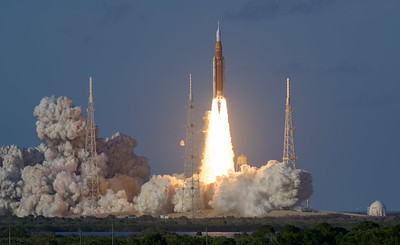
Artemis II blasts off April 1 for its journey around the moon.
The Integrity capsule of the Orion spacecraft from the Artemis II mission splashed down off the coast of San Diego at 7:07:27 p.m. CST on Friday, marking the end of a mission that lasted 9 days, 1 hour, 32 minutes, and 15 seconds, and took the astronauts 252,756 miles from Earth. Artemis II was one part of the larger Artemis program. That program aims to put humanity back on the moon in a more permanent way.
“With Artemis II complete, focus now turns confidently toward assembling Artemis III and preparing to return to the lunar surface, build the base, and never give up the moon again,” NASA Administrator Jared Isaacman said as he welcomed the astronauts home.
To understand how this historic feat came to be, you have to understand the Artemis program as a whole, and to do that you have to start at the beginning with Artemis I.
According to the NASA website, the long-term goal of the Artemis program is to put a base on the moon to conduct equipment tests in micro gravity, or gravity less than Earth’s, as well as tests of lunar material for scientific discovery. No one is quite sure what exactly that base entails.
“I’m excited to see the experiments that they might set up,” said Dr. Jenny Sattler, head of the Science department and an astronomy professor. “First, living in microgravity: are they going to bring cellular organisms to see how they respond to microgravity. I also want to see them bring samples back to Earth because they evidently can’t drag all of the scientific equipment that we have available to us on Earth up there with them. … I think [the moon base] is the first step in actually looking at humans traveling to other planets. I think it would be a place to stop, maybe restock, on their way to, for example, Mars.”
Dr. Rasika Mohottige, a condensed-matter physicist and assistant professor of physics, said that setting up a solar farm on the moon would probably be the easiest part of establishing a moon base. Mohottige recently published a study on the materials used in solar panels that makes the solar cells more resistant to radiation while maintaining most of their effectiveness.
Most earthly solar panels absorb light using silicon-based cells, but these cells are not resistant to radiation. Space based solar panels absorb light with a layer of film known as CIGS, which stands for copper, indium, gallium and selenide. This CIGS layer also contains a buffer layer of cadmium, which is extremely toxic and hard to get rid of, making it more expensive for manufacturers to use.
So, what are the alternatives to cadmium that don’t degrade the energy efficiency but maintain the cadmium’s original purpose? Mohottige and his colleagues in the study asked that same question and found that if you replace the cadmium buffer layer with a transparent coating of zinc stannate, it will fulfill the cadmium’s original role and not hinder the efficiency of the solar cell, making it a good candidate for potential use on the moon.
Whatever the moon base actually ends up being, it will act as a proof of concept, and a testing ground, for a manned trip to Mars, much like how Artemis I was a proof of concept and test for Artemis II.
Artemis I launched on Nov. 16, 2022, with a similarly record-breaking flight path as Artemis II, just without the people. The purpose of this mission was to test the new rocket, which NASA and Lockheed Martin had to design specifically for this mission, before any humans were involved. This new spacecraft is called Orion, and it is the only spacecraft capable of crewed deep-space flight and highspeed return to Earth from the vicinity of the moon, according to NASA. This new spacecraft can only be carried out of Earth’s gravity by the Space Launch System (SLS) rocket, which is NASA’s super-heavy-lift rocket.
After the successful splashdown of Artemis I on Dec. 11, 2022, NASA began work on Artemis II, tweaking the design of the new spacecraft and flight trajectory, based on what they had learned from Artemis I.
“With Orion safely returned to Earth we can begin to see our next mission on the horizon which will fly crew to the moon for the first time as a part of the next era of exploration,” said Jim Free, former NASA associate administrator for the Exploration Systems Development Mission Directorate, on the NASA website. “This begins our path to a regular cadence of missions and a sustained human presence at the moon for scientific discovery and to prepare for human missions to Mars.”
After the changes to Artemis II were finalized, NASA launched the rocket on April 1, and began testing the rocket’s and the spacecraft’s capabilities in deep space with humans inside. Much like the previous mission, the information gathered from the space flight and splashdown will help NASA to tweak the design of Artemis III, giving it the best shot of delivering the first steps of a base on the moon.
With the possibility of a moon base being established coming closer to being a reality, many are saying that the technology and information gained from these missions might be more significant than the original Apollo landings.